Publications

Themis: Software-Defined Hardware Prefetching

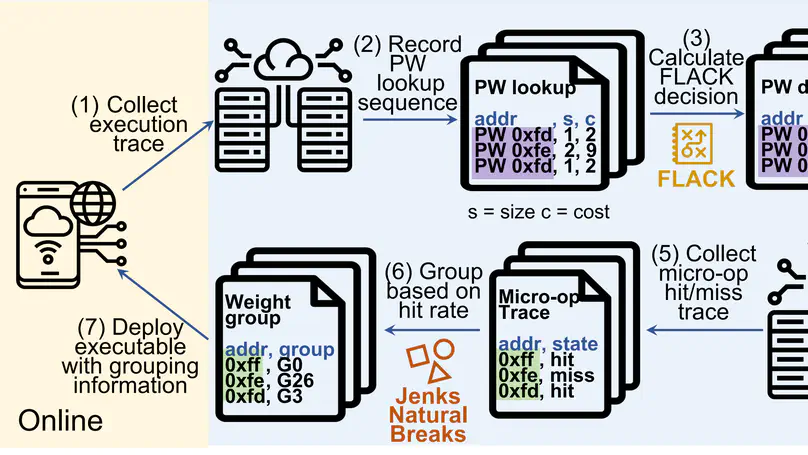
Data cache misses represent a significant portion of stall cycles in datacenter workloads. Hardware prefetchers that reduce such stalls by fetching data ahead of time have become increasingly sophisticated. However, to achieve high coverage, they have to prefetch aggressively, generating many inaccurate accesses that waste memory bandwidth. This is problematic in datacenter environments where memory bandwidth is a limited resource due to high multi-tenancy. We observe that for datacenter workloads, inaccurate prefetches can be effectively filtered on a data page granularity, without sacrificing prefetch coverage. However, storing per-page metadata about prefetch usefulness in hardware is costly, so we propose a novel hardware-software interface for data prefetching: The software directs the hardware on where to prefetch, and the hardware identifies and issues prefetches in the regions of interest. We propose Themis, a profile-guided hardware prefetching solution that implements this new interface. Themis utilizes page-level hints stored in page-table entries to disable the prefetcher for certain data pages at runtime. Themis requires no binary or ISA changes and can be used to optimize processes without disrupting their execution. Themis is also orthogonal to existing works on prefetching and can be applied to optimize any hardware prefetcher. Our results show that Themis is able to achieve around 40% reduction in useless prefetch requests, resulting in speedup for all the evaluated prefetchers for datacenter workloads, including 4.1% for BOP, 3.1% for SPP+PPF, and 1.4% for Pythia.

Accelerating Large-Scale Reasoning Model Inference with Sparse Self-Speculative Decoding

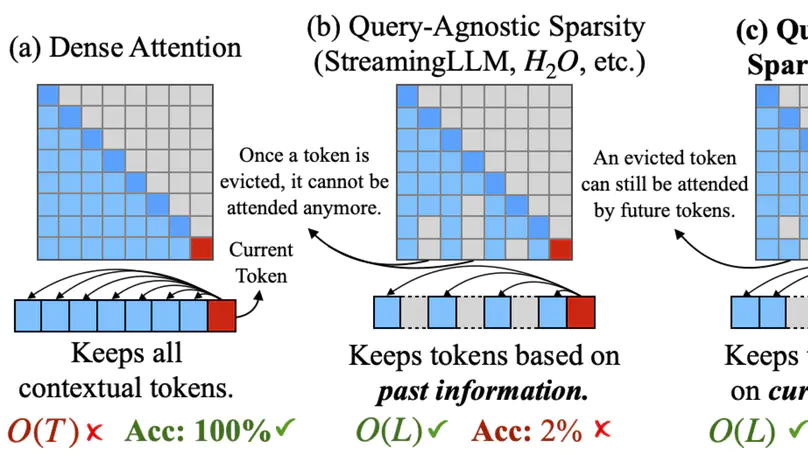
Reasoning language models have demonstrated remarkable capabilities on challenging tasks by generating elaborate chain-of-thought (CoT) solutions. However, such lengthy generation shifts the inference bottleneck from compute-bound to memory-bound. To generate each token, the model applies full attention to all previously generated tokens, requiring memory access to an increasingly large KV-Cache. Consequently, longer generations demand more memory access for every step, leading to substantial pressure on memory bandwidth. To address this, we introduce SparseSpec, a speculative decoding framework that reuses the same model as the draft and target models (i.e., self-speculation). SparseSpec features a novel sparse attention mechanism, PillarAttn, as the draft model, which accurately selects critical tokens via elegantly reusing information from the verification stage. Furthermore, SparseSpec co-designs self-speculation with three system innovations: (1) a unified scheduler to batch token drafting and verification, (2) delayed verification for CPU/GPU overlap, and (3) dynamic KV-Cache management to maximize memory utilization. Across various models and datasets, SparseSpec outperforms state-of-the-art solutions, with an up to 2.13x throughput speedup.

BlendServe: Optimizing Offline Inference with Resource-aware Batching

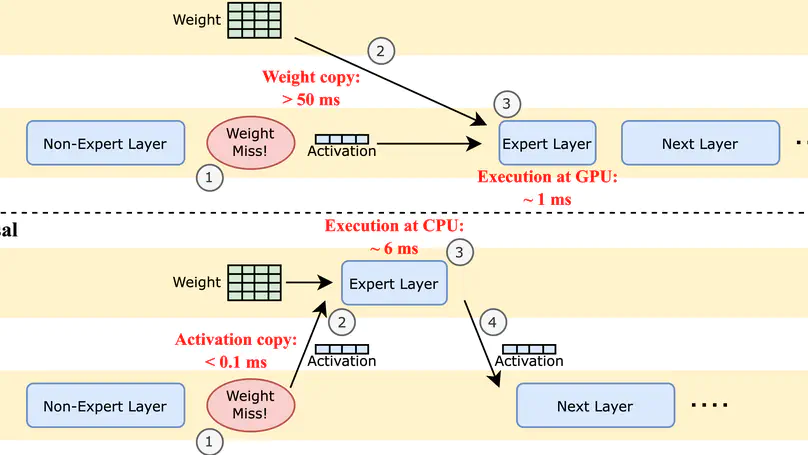
Offline batch inference is gaining popularity as a cost-effective solution for latency-insensitive tasks, such as model evaluation and data curation. As the latency objective is highly relaxed, maximizing throughput is the primary goal in offline inference. Previous studies focused solely on throughput optimization within a batch. However, the diverse resource demands (compute-intensive vs. memory-intensive) across a wide range of applications make these approaches less effective, as imbalanced resource demands between batches restrict optimization opportunities.

Our insight is to create batches with mixed compute- and memory-intensive requests through request reordering to maximize resource overlapping. However, such a request schedule can conflict with the schedule that maximizes prefix sharing, a widely-used performance optimization, causing suboptimal inference throughput. In this paper, we first build a performance model to analyze request resource demands. Based on it, we design BlendServe, which harmonizes both resource overlapping and prefix sharing to maximize throughput. BlendServe organizes all requests using a resource-aware prefix tree and proposes a dual scanning algorithm to obtain the request schedule. Our evaluation on various models and workloads shows that BlendServe can achieve up to 90% of the optimal throughput.

Atom: Low-bit Quantization for Efficient and Accurate LLM Serving

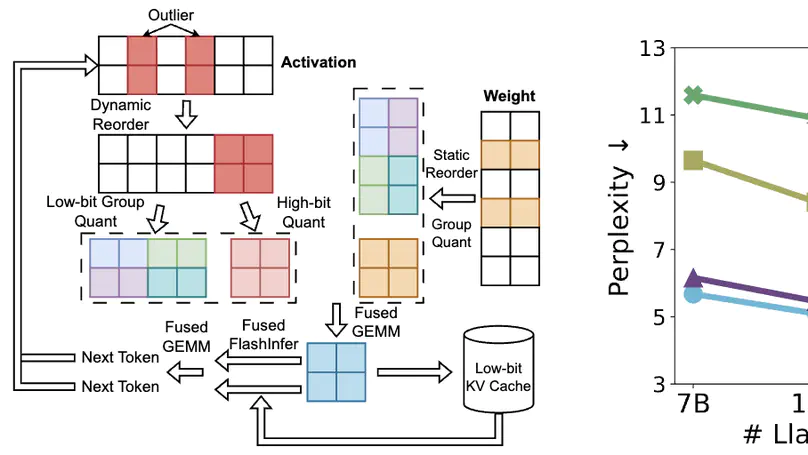
  • Use activation and weight low-bit quantization to improve throughput.